When someone dies without a valid will, the legal term is that they died intestate. Any property that was owned joint tenants with rights of survivorship, which is frequently the case with marital assets, will pass to the surviving spouse without the need for a court process. Any assets that the deceased owned individually go through a process called estate administration (people frequently call this probate, although probate technically is the process of proving the validity of a will).
For intestate estates, during estate administration, the court will appoint an administrator (similar to an executor) to handle the process, which includes paying the deceased’s debts, funeral expenses, court and administrative fees before distributing the deceased's assets to his or her heirs. The order in which debts must be paid and the distribution to heirs is determined by the North Carolina intestate succession laws. We’ve provided a summary of the distribution rules below, or you can review the North Carolina intestacy statutes here.
North Carolina Intestate Succession Laws
Under the North Carolina statutes, if you are survived by:
1. No spouse or children, with parent(s) living: Your entire estate will pass to and be divided equally among your parents. If only one parent is still living, then everything will pass to the living parent.
2. Your spouse and parents, but no children: Your spouse will receive the first $100,000.00 of personal property, one-half (1/2) of the remaining personal property, and one-half (1/2) of all real estate. Your parent(s) will receive one-half (1/2) of the remaining personal property and one-half (1/2) of all real estate.
3. Your spouse only, no children or parents living: Your spouse will receive all property that could pass under a will.
4. Your spouse and one child: Your spouse will receive the first $60,000.00 of personal property, one-half (1/2) of the remaining personal property, and one-half (1/2) all real estate. Your child will receive one-half (1/2) of the remaining personal property and one-half (1/2) of all real estate.
5. Your spouse and two or more children: Your spouse will receive the first $60,000.00 of personal property, one-third (1/3) of the remaining personal property, and one-third (1/3) of all real estate. Your children will evenly split the remaining two-thirds (2/3) of personal property and real estate.
6. One or more children, no spouse surviving. All of your property and possessions will be divided evenly among your children. If a child has predeceased you, their share will pass to their lineal descendants if they have any.
7. Neither spouse, nor children, nor parents are surviving. The intestacy laws provide additional rules for distributing your assets to more remote relatives such as siblings, grandparents, aunts and uncles, cousins, etc. In the event that you have no other legal heirs (i.e., blood relatives), your assets will pass to the State of North Carolina (this is referred to as “escheat“).
At first glance, these results might seem acceptable, but for many, there are a host of problems, especially if there are minor children, step-parents, or step-children involved. See Problems With Intestacy.

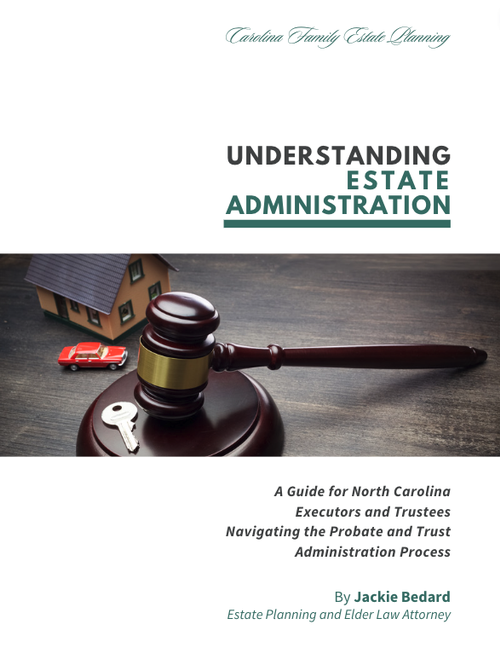
Read Our Guide, Understanding Estate Administration to Learn More
Request our guide, Understanding Estate Administration, using the form below to learn more about the estate administration process in North Carolina.
Understanding Estate Administration
If you are dealing with an intestate estate in North Carolina, or if you want to make sure your own estate is protected with a valid will or trust, please call us at (919)443-3035, or contact us online. We'll help you identify your next steps, and we will point you in the direction of resources that can help.